Tuesday, January 1, 2013

Best Bay Area Albums Of 2012


1. Ty Segall/Ty Segall & White Fence/Ty Segall Band - Twins/Hair/Slaughterhouse.  Ty Segall is one of those artists you can watch grow.  This isn’t a guy who sits down and decides to write an opus; rather, he seems to realize out ideas as soon as they enter his head.  Segall’s three albums this year--the solo Twins, the White Fence collaboration Hair, and his Ty Segall Band’s debut Slaughterhouse--do not sound like the culmination of the star’s career but rather major milestones in the development of an incredibly promising artist.  Twins is not all that different from his previous solo albums but distills his style into his most solid work yet; Hair and Slaughterhouse sound more as if they were made just for fun but are even more interesting, providing insight into Segall’s appetite for both consuming and making quality rock n’ roll.

2. E-40 - The Block Brochure: Welcome To The Soil 1.  E-40 may forever be best known for his hyphy-era hit “Tell Me When To Go,” but he’s still making music at an insanely prodigious rate even long after hyphy has become an anachronism.  His massive three-part anthology The Block Brochure: Welcome To The Soil (particularly the first part) is remarkable not only for its vastness but for its diversity--E-40 truly tries it all on this album.  Yet the music never sounds like anything but E-40 music, even when other MCs show up; it’s as if the one man has colonized the entire genre and maintained a stable and (usually) benevolent rule for the duration of the album.

3. Carletta Sue Kay - Incongruent.  There’s something inherently goofy about Carletta Sue Kay’s music and persona, but on the remarkable debut album by Randy Walker’s female personal/band, the silliness only adds flavor to the genuine passion that drives this record.  Walker’s gender-bending voice packs the power of a genuine soul diva, no matter what vocal personality he takes on.  Yet while Walker’s voice is a central part of what makes this record so engaging, the lyrics are also excellent, merging sharp witticisms with theatrical melodrama and raw soul emotion.

4. Local Hero - From Timid To Timbuktu.  The debut full-length from Berkeley indie-poppers Local Hero keeps its feet firmly on the ground even as the distinctions between the mundane and the fantastical blur together.  Bandleader Alex MacKay’s songwriting is more expansive than ever--whether he’s penning Dan Bejar-worthy couplets (“Black & White,” “Lady Wisconsin”) or ruminating on the human condition (“Piedmont Girls,” “Once More With Feeling,” MacKay imbues everyday life with almost theatrical whimsy, finding depth in the mundanity of his surroundings by filtering it through an artist’s eye. 

5. Reid Saw A Ghost - Mad Scary EP.  On their immensely promising debut EP, Fremont band Reid Saw A Ghost showcase their Epic Meal Time approach to music, which chiefly entails throwing as much stuff as possible on top of a foundation of strutting punkaboogie.  This is pop music played with the gleeful, anything-goes madness of a free-for-all jam session, ultimately sounding less like party music than the musical equivalent of an actual party--people are making complete asses of themselves, everything is out of order, but the chaos screams nothing but good vibes.  

6. Dylan Marx - Sod’s Collection Of Bitter Songs.  The UC Santa Cruz-based Dylan Marx’s debut release, the 6-track collection Sod’s Collection of Bitter Songs, showcases his mastery of deceptive simplicity.  Marx’s arrangements often sound grand, but never once do they overpower the album’s backbone of stark, introspective folk.  Marx himself does not provide many particularly brilliant or quotable lines on this album, but this is not a detriment to the album--Sod’s Collection of Bitter Songs is a singer-songwriter album that feels like a full, immersive experience.

7. Girl Named T - Wait By The Rabbit Hole.  Theresa “T” Sawi says her second album was inspired by the Beach Boys’ concept of the “pocket symphony.”  But while the Beach Boys applied symphonic ideas to their sound as well as the structure and scope of their work, Girl Named T is an artist who seems to work best in miniature.  The songs on Wait By The Rabbit Hole are two to three minutes each, but these songs are more expansive than anything on her 2010 debut Hey Liebe, mixing whooshing-by early-rock songcraft with classic-rock grandeur.

8. Fever Charm - Sail Away.  Fever Charm apparently snuck into a recording studio and used roughly 20,000 dollars worth of equipment to record Sail Away.  As this is probably the best-produced, best-sounding Bay Area rock record I’ve heard this year, it’s safe to say their chutzpah paid off.  Sail Away is one of the pop-savviest, most energetic, um, compilations of songs I’ve heard in a long time, delivering on the promise Fever Charm displayed on their earlier singles and EPs and demonstrating how studio sparkle can be just as powerful as lo-fi grime.

9. Rin Tin Tiger - Toxic Pocketbook.  Though the first EP by San Francisco folk trio Rin Tin Tiger was quality hoedown material, their second release is much more varied and even experimental.  Though there are plenty of typically Rin Tin Tiger songs, many of these songs use dissonance and stripped-down textures to convey and emphasize the longing and melancholy that’s been part of their aesthetic.  If Toxic Pocketbook isn’t always a blast, it’s an equally strong album and a much stronger case for Rin Tin Tiger’s potential to create something truly brilliant.

10. Mark Nelsen - Childish Songs.  Mark Nelsen a singer and a songwriter, but he’s hardly a singer-songwriter--on his solo debut Childish Songs, he’s still writing rock-band songs.  On songs like “Saluka & I” and “Oh! Romance,” Nelsen treates pop history as a hip-hop producer would, adding a dash of Beck here and a dash of Wayne Coyne there but keeping on the better side of the thin line between influence and pastiche.  The result is an album that’s unpretentious without being middle-of-the-road, one that borrows from the past but never once sounds nostalgic or retro.

Monday, December 31, 2012

Best Bay Area Songs Of 2012


1. Carletta Sue Kay - “Sloppy Kisses.”  There are tons of songs like “Sloppy Kisses”-- silly, dark-humored verses contrasted with a romantic, aww-inspiring chorus--but not many are as powerful as Carletta Sue Kay’s alternately funny, sweet, and devastating ballad.  Each thing Kay, a.k.a. former Amoeba Records employee Randy Walker, claims not to like in this song provides an insight into the (wo)man’s life, from “phone booths in Europe” (I’m sure there’s a good story behind that line) to his very own father.  Yet for all the pain in this song, Walker seems to be happy and appreciative of his life, especially when his lover’s sloppy kisses are part of it.

2. Squidopus - “Sushi Explosion.”  Berkeley duo Squidopus’s remarkable debut single feels at first less like an explosion than a fire spreading.  The most unique and interesting quality of this song is the way it unfurls, with each mini-section slowly unraveling and revealing something new while keeping to the same sonic template.  Slamming drums and chatty guitars give way to psychedelic atmospherics and fractured funk, allowing the song to drag you into its depths like a miniature Pink Floyd album.  And at the end, it explodes.

3. Ty Segall - “You’re The Doctor.”  Twins, the most nondescript yet arguably the most solid of the three albums Segall released this year, pushed neither Segall’s style nor rock in general forward; it was content to encapsulate both of them, and the same could be said for its second track, “You’re The Doctor.”  With its Chuck Berry guitars, indelible glam-rock chorus, and metallic guitar-thrashing, it sounds classic enough to be a homage to something.  But it’s not--this is no more or no less than a half-century of history mashed up into 121 seconds of criminally catchy garage-pop goodness.

4. The Inq - “Monster.” “Monster” is a thrilling mix of the physical and the intangible, a song that swirls and drifts while maintaining momentum throughout.  The drums are plushy and understated while still driving the song forward, and the guitars blur together like clouds of smoke in a hotboxed room.  Above it all, frontman Dillon Lee yelps insistently through muffled distortion, at once a James Brown-style bandleader and an ingredient in the overall sonic brew.

5. False Priest - “Novato.”  At first, nothing in “Novato” moves with any ease.  Over a riff that lurches forward as awkwardly as a newly hatched chick, Greenwald repeats a few cyclical mantras to distract himself from his old life and focus on his current situation.  Yet as the song develops, everything seems to settle, and by the end, that same riff has become an exhortation.  Even if the present isn’t much better than the past, it’s always best to move on.

6. Thee Oh Sees - “Lupine Dominus.”  Vocals, guitar, bass, drums, keys--how much further could you go with these instruments?  “Lupine Dominus” is John Dwyer’s case for “a lot.”  All the elements on this song are familiar, but they work together in ways I haven’t heard on any rock song--the punctuating organ stabs, the sander-to-the-face guitars, and Dwyer’s ominous voice are brought together in a cloudy room where they dart around each other, occasionally collide, and finally fight to the death.

7. Local Hero - “Black & White.”  Local Hero’s name is as half-modest as their music; though there’s a sense of the fantastic in the images lyricist Alex MacKay creates, it’s always anchored by the human flaws that prevent such fantasies from actually being realized.  On “Black & White,” our protagonist seems to be having a great night and a great life, but there’s a gap in it and he’s doing his best to piece it together.  When you live in a world as vibrant as the one MacKay and company create, it’s not hard to understand why.

8. Main Attrakionz - “Green On Sight.”  The “cloud rap” appelation with which East Bay duo Main Attrakionz are frequently saddled might suggest something formless and drifting.  Yet “Green On Sight,” the first song on their Bossalinis & Fooliyones album, proves that these guys can groove if they want; its minimal, lurching beat harnesses and guides the duo’s druggy lyrics and spacey atmospherics. 

9. Frak - “The Jewish Lupe Fiasco.”  Alex Fraknoi apparently got a chance to talk to Lupe Fiasco at some point; I don’t know how cosmic an event that is in the life of the MC known as Frak, but if I had just talked to a famous rapper I’d be pretty damn happy.  “The Jewish Lupe Fiasco” sounds like the high from having your day made; you can practically see the grin on Frak’s face as his rhymes swing nimbly above an insane beat from the St. Valentinez’ Esquire.

10. Ty Segall & White Fence - “I Am Not A Game.”  “I Am Not A Game” is the sort of almost novelty-like tribute to ‘60s garage-psych that every Bay Area band seemed to have been doing between 2010 and early 2012. But don’t let that tacky little organ fool you: “I Am Not A Game” is a reminder of just why the world became so interested in San Francisco garage-rock in the first place. The duo uses lo-fi production squarely to their advantage, and their nostalgic touches hardly sound ironic--just check out that epic, Woodstock-worthy guitar solo at the end.

11. Sarchasm - “Song 101.”  Most songwriters write about what inspires them, but “Song 101” is the best song I’ve heard about the mere lack of inspiration.  The easiest thing for one with writer’s block to do is write about writer’s block, but leave it to Sarchasm to beget a great pop song--and a standout from an already good album--from what is ordinarily a masturbatory and fruitless cycle.  

12. The Strangers - “Traveling Song.”  The Strangers float somewhere in limbo between San Francisco’s teen rock scene and its older garage-rock boom; they possess solid enough chops and good enough songs to distinguish themselves from either.  “Traveling Song” is among these tunes, a chugging blues-rocker that explodes into a fuck-all guitar stampede; though the groove alone is enough to get a listener hooked, the clincher is singer Alex Pollak’s magnificent blues growl.

13. The Fresh & Onlys - “Fire Alarm.”  “Fire Alarm” stands out like an iceberg in the Golden Gate among the romantic Chris Isaak-isms of the Fresh & Onlys’ Long Slow Dance album; with its robo-cool New Wave synths and distant vocals, it’s no less chilly.  Though the “whoa-ohs” might evoke Young the Giant’s “Cough Syrup,” “Fire Alarm” relies as much on atmospherics as hooks; in fact, it’s the balance between the two that makes this song so effective.

14. Girl Named T - “I Fell In Love With The World Today.”  The best song on Girl Named T’s Wait By The Rabbit Hole sounds like a ‘70s piano rocker filtered through a contemporary Top 40 song, keeping only the best of both--the celebratory, twirling-in-the-street vibe of the former and the radio-friendly sheen of the latter.  Yet unusually for a pop tune this tight, there’s a bliss-out factor--it’s as easy to lean your head back and ride the good vibes as it is to dance to this song.

15. Mark Nelsen - “Saluka & I.”  When he’s not melting brains with Electric Shepherd, Mark Nelsen writes subtly psychedelic songs that sound like those reflections on life that come between massive bong rips.  “Saluka & I” is the best of the tracks on his excellent debut Childish Songs, progressing from strummy ballad to space-rock blowout without sacrificing the sentimentality of its theme.

16. Reid Saw A Ghost - “Spacy Stacey.”  Though Reid Saw A Ghost’s excellent debut EP Mad Scary succeeded largely through its short yet manic and idea-filled songs, centerpiece “Spacy Stacey” stands as their most successful experiment.  For the first two minutes, it’s a pretty straightforward, mid-tempo pop-punk song; it then gives way to something softer, jazzier, and at times straight-up beautiful, evoking the zoned-out television bliss that is a favorite lyrical subject of the band.  

17. Handshake - “Narcissus.”  “Narcissus” is essentially Handshake’s shot at writing a hard rock song, possessing none of the intimate, in-the-room-with-the-band feel of Handshake’s early singles.  This is a song built for playing live, designed for clubs or even arenas.  If the music on the band’s debut Sleeping, Snarling felt like a refinement of the sound on earlier Handshake singles, “Narcissus” feels like a leap forward.

18. Comodo Complex - “Melting In The Astral Plane.”  There are two immediately striking differences between “Melting In The Astral Plane” and Comodo Complex’s previous work.  The first is Lucas Fendert’s vocals; the second is how much heavier the guitars are than on anything they’ve recorded before.  These factors suggest that the band may be delving deeper into the “heavy” strain of psychedelia, but the band still sounds most comfortable when they let their music float into space, as during the song’s epic coda. 

19. Lil B - “BasedGod Fucked My Bitches.”  Lil B is a pop-culture institution by this point, and if “BasedGod Fucked My Bitches” is any indication, he knows it.  This song is his mission statement, jacking Daft Punk’s “One More Time” and warping it to conform with the BasedGod’s mad and unique vision of the world.  It’s also one of the most fun songs he’s recorded in ages; this is the sound of Lil B laughing with his audience rather than merely letting his fans laugh at him.  

20. Minute 2 Midnight - “Tell Me.”  “It’s catchy” is the most common defense of pop music; it’s not a bad one either, especially when songs like “Tell Me” exist.  Though there are countless bands both in and outside the Bay Area with similar ambitions and influences as San Ramon pop-punkers Minute 2 Midnight, not many of them can claim to have engineered an earworm as ravenous as this song’s chorus.

Monday, December 17, 2012

New Ty Segall, Cartoon Bar Fight, Eager Eyes

TY SEGALL
Twins
* * * * 1/2
BEST IN THE WEST

Twins, Ty Segall’s third record of the year (and the first one credited solely to Ty Segall) will sound instantly familiar to anyone who’s followed the San Francisco garage-punk savant for even a few albums.  There are elements of Melted’s spastic monkeying, Goodbye Bread’s deliberation, and Slaughterhouse’s bad-trip cacophony; it would not be an overstatement to say that there’s not one song here that would be out of place on at least one of his other records.  But what distinguishes Twins from any other record Segall’s done is its consistency.  Twins has the fewest skippable tracks of any Segall record, as well as the catchiest hooks (I’ve had “You’re The Doctor” stuck in my head for about thirty-six hours as of this writing) and the all-around best songs.  It’s unlikely that this album will be perceived as his mission statement--he’s probably got at least six or seven good albums left in him, and he still sounds like he’s developing and refining his sound.  But if you’re trying to find an entry point into the man’s ever-expanding catalogue--or just trying to get a clear picture of what he’s all about--Twins is probably your best bet.  

CARTOON BAR FIGHT
Reincarnate
* * * 1/2

On their debut full-length Reincarnate, San Jose five-piece Cartoon Bar Fight take familiar folk-pop sounds and glaze them with a thick coating of goth atmosphere; think Ingrid Michaelson as possessed by the spirit of Disintegration-era Robert Smith.  The best moments on Reincarnate come when the omnipresent gloom almost threatens to envelop the music but is just barely kept at bay; this is exemplified by “Fox And The Grapes,” where a gorgeous “if I were you” refrain is smeared black and left in the late-afternoon sun to dry.  Occasionally, the band wanders a bit too far into the clouds, particularly on “Hymn” and “The Valley”--both fine songs but underwhelming given that the seven preceding songs create largely the same mood.  Yet on the surreal title track, the band finds its way back into the light and ends the album on a high (and highly promising) note.  

EAGER EYES
Waterfront
* * *

It’s hard to imagine Eager Eyes’ sound filling up a stadium, but it’s just as difficult to imagine them stranded on the local circuit forever.  On both their debut EP and their newest offering, the three-song sampler Waterfront, they’ve eschewed the arena-ready anthemization that made their buddies Finish Ticket a fixture of the Bay Area rock scene; instead, they specialize in humble and unpretentious indie pop.  The tunes on Waterfront are largely cut from the same cloth as those on their first EP, but they’re more subdued and atmospheric; even the fast-based “Natalie” sounds more like a brisk walk than a determined leap forward.  While the band’s understated sound is a major part of their appeal, they’re almost a bit too modest on Waterfront--there’s nothing on here with the same starry-eyed determination that made earlier tracks like “First Impressions” and “Alarms” so likeable.  Yet it’s impossible to make any assessments about their progress or future direction on Waterfront--they’re just three songs waiting to be played and enjoyed.  

Monday, December 10, 2012

Catching Up, Pt. 1: The Teen Psych-Rock Contingent

COMODO COMPLEX
“Melting In The Astral Plane”
* * * 1/2
There are two immediately striking differences between Comodo Complex’s latest single “Melting In The Astral Plane” and the material on their self-titled EP from last year.  The first is Lucas Fendert’s vocals--in the past, most vocal duties were handled by guitarist Spencer Owings, whose smooth tones could not be more different from Fendert’s raunchy, ecstatic wail.  The second is how much heavier the guitars are than on anything they’ve recorded before.  These factors indicate that the band may be delving deeper into the “heavy” strain of psychedelia and turning away from the more atmospheric sound of their previous work.  This is further evidenced by the lyrics, whose references to “astral heartbeats” and “mercury bleeding” are closer to what one might expect from a stoner-metal band like Sleep or Electric Wizard than from a more straight-up psych-rock band.  Yet the band still sounds most comfortable when they loosen their grip on their music and let it float into space, as they do during the song’s epic instrumental coda. 

THE INQ
“Monster”
* * * *

At first glance, “Monster” isn’t that different a song from the Inq’s previous single “Z?”--it’s a barrelling jam with an insistent rhythm and a mix of spidery lead guitars and fuzzier ones in the background.  Yet it’s the subtle differences that make “Monster” such a monumental improvement on its predecessor.  While the studio polish on “Z?” considerably blunted its potential sonic impact, the layers of distortion on the self-produced “Monster” behoove the song greatly.  The drums are plushy and understated while still driving the song forward, and the guitars blur together like clouds of smoke in a hotboxed room.  Above it all, frontman Dillon Lee yelps insistently through muffled distortion, functioning as both a James Brown-style bandleader and a part of the overall sonic concoction.  The overall result is a thrilling mix of the physical and the intangible, a song that swirls and drifts while maintaining momentum throughout.

TAILED GHOST
“HIDE // EATEN”
* * *

On his latest single as Tailed Ghost, Inq frontman Dillon Lee creates the framework of a pop song, with an omnipresent synth melody and vaguely girl-groupish drums, and inhabits the empty spaces rather than rising above the mix as a frontman.  Though the melody becomes somewhat overpowering as Lee’s vocal presence becomes more pronounced, it soon fades out and yields to an unsettling, Xiu Xiu-like congregation of synth arpeggios.  It’s almost as if the song is malfunctioning, its pop facade disintegrating and revealing something unfamiliar and possibly malevolent.

Thursday, September 13, 2012

New Local Hero, Thee Oh Sees

LOCAL HERO
From Timid To Timbuktu
* * * * 1/2
BEST IN THE WEST

Local Hero’s debut release, last year’s excellent The Aldgate EP, succeeded by pushing reality to the periphery but never eliminating it entirely in favor of the globe-trotting reveries at the music’s front and center.  From Timid To Timbuktu, the Berkeley quartet's full-length, reverses this paradigm, keeping its feet on the ground even as the distinctions between the mundane and the fantastical blur together.  Alex MacKay’s field of vision on Timbuktu is mainly limited to what’s going on in front of him (and behind his back), and the locales are far more familiar than the Barcelonas and Champs-Elysees of The Aldgate--a theater, a cold rooftop, a few disparate U.S. states, Piedmont, the metropolitan sprawl.  But MacKay’s songwriting is more expansive than ever and is what ultimately makes Timbuktu stand out as the better of the band’s two releases so far.  Whether he’s penning Dan Bejar-worthy couplets (“Black & White,” “Lady Wisconsin”) or ruminating on the human condition (“Piedmont Girls,” “Once More With Feeling,” MacKay imbues everyday life with almost theatrical whimsy, finding depth in the mundanity of his surroundings by filtering it through an artist’s eye.  If The Aldgate felt like a daydream, Timbuktu feels like the inspired moments of consciousness that feed and nurture our fantasies.

THEE OH SEES
Putrifiers II
* * *

It’s been nearly a year since Thee Oh Sees released Carrion Crawler/The Dream, a hiatus of Vashti Bunyan proportions by the standards of a band who once released so many records that finding an entry point was near impossible.  Since then, the band’s reputation has evolved from yet another stereotypically prolific San Francisco garage-rock band to one of the most formidable rock n’ roll bands in America, both live and in the studio.  It’s a shame that Putrifiers II, the follow-up to Carrion Crawler, only intermittently justifies that reputation.  The logic behind this album is understandable--it’s Thee Oh Sees’ most accessible album to date, bordering on straight poppy on songs like “Flood’s New Light” and “Goodbye Baby,” and will likely be the most-recommended Thee Oh Sees album if only for its relative ease on the ears.  But these songs sound uncharacteristically restrained, with bandleader John Dwyer sounding bored through most of it and the band plodding away joylessly.  Gone is the jam-session spontaneity that made Carrion Crawler such a blast, but the band counter-intuitively sounds less tight, almost as if they’re playing the music out of obligation rather than passion.  However, there are enough good songs to mostly redeem this album, including the plodding title track and the warped string ballad “Wicked Park.”

Monday, September 3, 2012

New Mark Nelsen, Solwave

MARK NELSEN
Childish Songs
* * * *
BEST IN THE WEST

Mark Nelsen is a singer and a songwriter, but he’s hardly a singer-songwriter.  The Electric Shepherd frontman is by no means a bad lyricist, but on his solo debut Childish Songs, he’s still writing rock-band songs, full of crypticisms you don’t have to even remotely understand to dig the music.  His strong suit is as an arranger, and the arrangements on Childish Songs are consistently inspired and vital.  On songs like “Saluka & I” and “Oh! Romance,” Nelsen treates pop history as a hip-hop producer would, adding a dash of Beck here and a dash of Wayne Coyne there but keeping on the better side of the thin line between influence and pastiche.  The result is an album that’s unpretentious without being middle-of-the-road, one that borrows from the past but never once sounds nostalgic or retro.

SOLWAVE
Out Of The Mayhem EP
* * *

Solwave pride themselves on their inability to be categorized, and while this claim has plenty of truth, it’s primarily due to the band’s willingness to experiment with different sounds and genres rather than their making music that’s actually uncategorizable.  On their second EP, Out Of The Mayhem, the San Francisco quartet maps out a defined space within the pop music spectrum and proceeds to explore every nook and cranny of it.  “Fire It Up” and “Voodoo At High Noon” are sweaty arena rock, with titanic drums and omnipresent Hot Fuss synth buzz; “Ride” is a dance-rock rave-up; “Shuffler” is heart-on-sleeve power pop.  The band stumbles on the former two songs, particularly “Voodoo At High Noon,” which sounds like the ‘70s and the ‘00s put in a blender with the lid off.  But on the latter two tracks, they sound completely in their comfort zone, suggesting that just like their heroes the Killers, they may just be a goofy pop band at heart.

Saturday, September 1, 2012

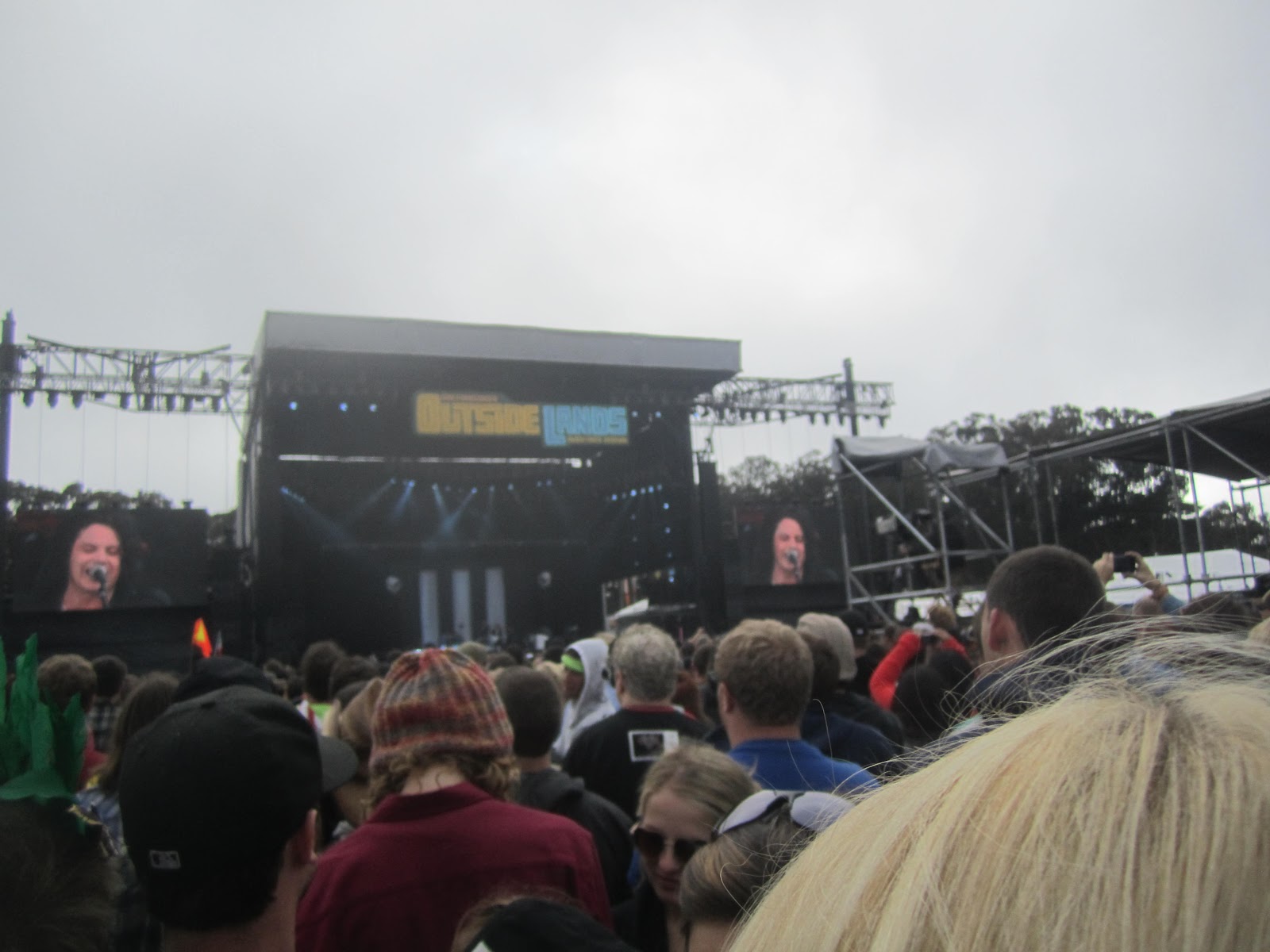
Outside Lands, Day 3


REGINA SPEKTOR
* * * 1/2

I started Sunday a bit late.  There literally wasn’t a single act I knew of or wanted to see until Jack White, so when I arrived I ultimately decided to stay by the main stage and watch Regina Spektor’s set.  Though I can’t profess to be a fan of Spektor’s music, it was certainly interesting to witness her music in a live festival setting.  The setup was minimal--a cellist, a drummer, a synth player, and Spektor on voice and keys.  Yet every note sounded so crystal-clear, every word so effortlessly comprehensible, that it was hard to imagine this was taking place at a festival with over a thousand people in attendance.  On the subject of the crowd, the audience at Spektor’s set was among the most diverse of any I witnessed--within a few feet of me, there were joint-passing hippies, an old woman who must have been eighty, a face-painted raver girl on her boyfriend’s shoulders, and a number of people waving inflatable sharks in the air.

JACK WHITE
* *

Maybe I just didn’t give Jack White a chance, or maybe everyone had already been to his surprise set in the forest earlier, but nothing about the main-stage set by the man hailed by many as the savior of rock n’ roll stood out to me.  The sound was sharp and tinny, as if the sound people were trying to replicate a garagey Third Man production, and the session musicians played as if they were boogieing for the first time in their lives.  Even “Seven Nation Army,” which can be a behemoth live if the version on the White Stripes’ Under Great White Northern Lights is any indication, sounded flimsy and insubstantial.  It was a set that could have rocked tremendously, but for whatever reason, it just didn’t.

STEVIE WONDER
* * * * *

Of all the acts I saw, Stevie Wonder was the only one (aside from Sigur Ros) who thoroughly met my expectations.  I came to Stevie’s set expecting a lively, energetic set featuring some of the greatest pop songs ever written, as played by one of the most technically proficient musicians ever to perform popular music.  As Wonder is one of maybe four or five currently active artists who might play a show fitting the description, it’s safe to say I got exactly what I came for.  All the classics were there, from “Higher Ground” to the earth-moving “Superstition” to “Signed, Sealed, Delivered,” plus some deep cuts I’d never even heard and a truly moving tribute to Michael Jackson by way of “The Way You Make Me Feel.”  Wonder’s voice, keyboards, and band were every bit as funky (and frequently more so) as on record.  For two glorious hours, Wonder single-handedly made up for the rest of this comparatively sleepy day and every other less-than-satisying experience I had at the festival, from Jack White to a fast-fading romance to some asshole who told me “you’re not as high as you think you are” towards what was luckily only the beginning of Tame Impala's set.